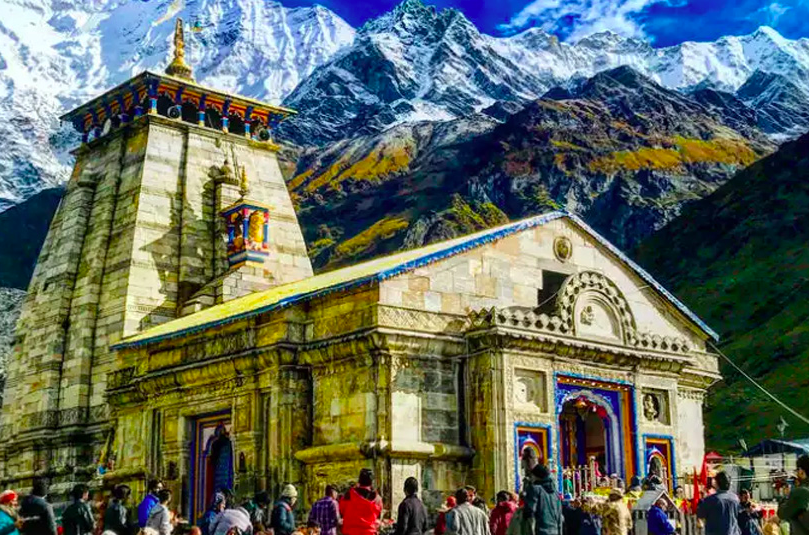
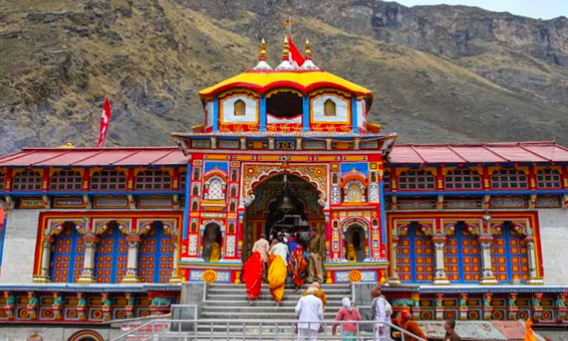
Uttarkhand is so rightly known as Dev Bhoomi or the Land of Gods. A nest to some of the most well-known and most sacred considered pilgrim spots, temples, and shrines which makes it a major attraction for tourists and pilgrims from all over the world.
Uttarakhand is home to the Char Dham which is considered one of the most important pilgrimages in Hinduism. Char Dham literally means “four abodes/seats”.
The Char Dham Yatra essentially covers the four pilgrim spots i.e. Yamunotri, and Gangotri. Kedarnath, Badrinath. It is pertinent to mention that the four pilgrim spots are also sources of four sacred rivers; Yamunotri- River Yamuna, Gangotri- River Ganga Kedarnath- River Mandakini, and Badrinath- River Alaknanda.
This pilgrimage is widely revered by Hindus. It is considered not just a test of faith but of willpower to travel to such remote locations to worship these shrines. It is considered a life-changing journey. Not only devotees but adventure seekers have also added to the popularity of the Char Dham Yatra.
The temples are surrounded by snow-clad mountains. These shrines remain closed to tourists for six months due to the extreme weather conditions at the altitude at which it is situated.
As soon as the winters set in, the doors of these temples shut for the pilgrims and tourists. There are various mythologies and stories attached to these sacred temples.
It is believed that one should complete the Char Dham Yatra in a clockwise direction. Hence, the pilgrimage starts from Yamunotri, proceeds towards Gangotri, onto Kedarnath, and finally ends at Badrinath.
The Yamunotri temple is dedicated to Goddess Yamuna and is nestled in a narrow valley, and the Gangotri temple dedicated to Goddess Ganga is situated in the district of Uttarkashi.
While Kedarnath temple which is dedicated to Lord Shiva lies in Rudraprayag. Badrinath has the most famous shrine Badrinarayan Temple dedicated to Lord Vishnu.
Covering all of the four spots is arduous but one of the most fulfilling experiences. The journey is a blend of spiritual, cultural, and adventurous elements.
DETAILED ITINERARY
Day 1: Haridwar to Barkot (Altitude: 1220 m)
- Commencing our journey from the holy city of Haridwar we shall drive to Barkot, a town in the Uttarkashi District.
Haridwar is located on the right bank of the Ganges at the foothills of the Shivalik ranges. The city holds importance for its traditions and history rooted in the ancient Vedic era. Held in high regards for its religious value, Haridwar hosts the very very famous Hindu festival or the greatest gathering of mankind, the Kumbh Mela.
- Haridwar has some religious places like Har Ki Pauri, Kankhal, Kushwart, the Mansa Devi temple and the Chandi Devi temple.
- Barkot is located at an altitude of 1,220 m in Uttarkashi on the banks of River Yamuna, known for its scenic beauty blooming green with vegetation. The apple orchards of Barkot are a beautiful site to watch while driving till there.
- We shall also pass through Mussoorie while on our drive to Barkot and will take a stop near Kempty Falls for lunch.
- You will also witness the very striking view of the Bandarpoonch Peak.
- Upon reaching Barkot, dinner would be served at Camp Veda, our campsite tonight.
Day 2: Yamunotri Dham Darshan and drive back to Barkot
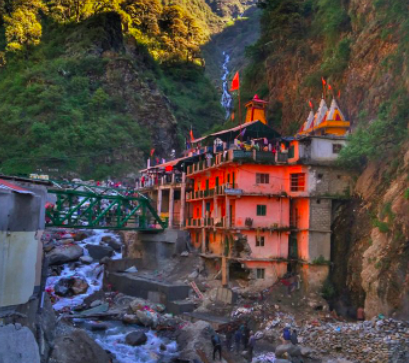
- Day 2 marks the beginning of our visit to the first of the four Dhams. Post breakfast we shall drive towards the Yamunotri Dham.
- The first stop will be Phool Chatti, from where a brief hike of around 6 kms for Yamunotri begins. This I considered a rather tough one as there is a steep inclination. The path is accompanied by tall green covered mountain peaks, Himalayan Shrubs, Rhododendrons and the Yamuna river flowing below.
- The view on this trek is what keeps one going. The valleys, the expansive views of the peaks and waterfalls.
- Yamunotri Dham is the seat of goddess Yamuna, the daughter of Yama (God of Death). It is said that taking a bath in the Yamuna River blesses a person with peaceful death.
- Another significant spot here is the Surya Kund, a sacred hot water spring. Many devotees come here with rice in a cloth and dip it in hot water to cook it. This cooked rice is considered as a Prasad and is offered to Divya Shila, a rock pillar outside the temple. You can also take a dip in the holy water of the Kund.
- After offering our prayers at the temple we head back to Barkot, rest and prepare for the next day.
Day 3: Drive from Barkot to Uttarkashi
- Uttarkaashi is home to many temples dedicated to Lord Hanuman, Goddess Durga, Bhairav, Laksheswar, and Parshuram to name a few. The very famous Nehru Mountaineering Institute is also located here along with some other attractions like Dodital Lake, Dayara bugyal, and the Maneri Dam.
- In the Skanda Puran, Uttarkashi is known to be the home of Lord Shiva when the Kalyug era begins.
- Uttarkashi is well-known for both its adventure activities like camping and trekking as well as its spiritual value.
- We shall drive from Barkot to Uttarkashi which is approximately 90 km away and takes around 4 hours to reach.
- The town is bordered by mountains on all sides. We will be visiting the Vishwanath temple here which is believed as the oldest one. The temple is placed in a huge area and comprises shrines of Markendeya, Rishi, Ganpati, and Sakshi Gopal. This temple has two things that are considered of significant importance, the Akhand Abhishek and Akhand Jyoti.
- The Shivalingam in the Vishwanath temple is also known as a part of the twelve Jyotirlingas. The infrastructure of the temple is ancient and worth observing.
- Apart from this, Uttarkashi has a full-fledged market, so if any last-minute utility is to be bought then it can be bought from here itself.
- We will stay in Uttarkashi for the night and proceed for Day 4 from here.
Day 4: Uttarkashi to Gangotri and Back to Uttarkashi
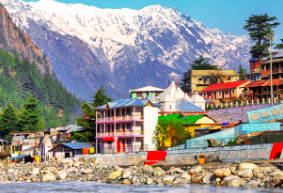
- Day 4 is going to be an exciting day as we would be heading to the second Dham today.
- Gangotri is the origin of the River Ganga and is an imminent pilgrimage in India. This is a major attraction for mountaineers, adventurers, trekkers, and devotees in India as it is one of the most acclaimed places in the Himalayas.
- The landscapes keep changing in this drive and only get better and much more mesmerizing as we pass through Harsil valley blooming with the mighty Deonar trees.
- In Gangotri, we shall go for a dip in the holy Ganga and to the revered Gangotri temple on the river bank which was built by Gorkha General Amar Singh Thapa back in the 18th Century.
- On arrival at Gangotri Dham worship Goddess Ganga, who is said to have descended on earth to absolve the sins of humankind. After witnessing the Aarti, everyone can soak in the beauty of the place and just be at peace and relax while witnessing the greenery around.
- We shall drive back to Uttarkashi the same day and have dinner at the hotel and stay there for the night.
Day 5: Uttarkashi to Guptkashi
- We shall begin day 5 early on with a drive with breakfast en-route to Guptkashi.
- The route to Guptkashi is absolutely mesmerizing and tranquil with the view of Mandakini River all along the way. We shall also take a small stop at the Tehri Dam which will be on the way. This Dam is known as the highest dam in the world. We will head again for Guptkashi from here.
- Guptkashi is also known as the “Hidden Varanasi”. Located on the way to Kedarnath, Guptkashi lies in the Mandakini Valley which blooms in the abundance of magnolia flowers.
- Guptkashi is nature’s paradise set against the backdrop of mighty snow-clad mountains like Chaukhamba.
- According to legend, the Pandavas from the epic Mahabharata were looking for Lord Shiva when the Lord hid in Guptkashi. As a result, the major shrine is devoted to Lord Shiva. Another draw is Manikarnika Kund, where the rivers Ganga and Yamuna are reported to meet.
- Witness the beautiful view of Rudraprayag and Ukhimath in the journey.
- When we reach in the evening, we will try and visit the Ardh Narishwar temple which is one of its kinds. What makes it so unique is the idol representing half Lord Shiva and Half Goddess Shakti. The temple looks strikingly beautiful at night with the lights.
- After relaxing in the serene environment of the temple, we will head to the hotel to rest and relax.
Day 6: Trek to Kedarnath
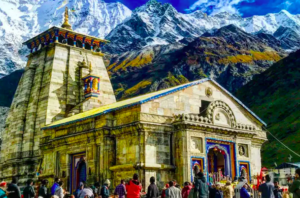
- Today will be a crucial milestone as we commence with our trek for Kedarnath today. The trek begins from Gaurikund.
- The trek to Kedarnath is an 16 km long arduous trek but still a fulfilling and satisfying journey of divinity.
- The trek starts from Gaurikund and we shall head towards Rambada Bridge to reach Jungle Chatti, which will be our first stop. This would be a distance of 4km. whoever gets tired can take some rest here before moving ahead.
- From Jungle Chatti, the next stop would be after 3 km in Bheembali.
- We will begin again from Bheembali after relaxing for a bit and trek up to Linchauli which is another 4 km away. The far stretched view of the mountain from Linchauli is breathtaking and extraordinary.
- Kedarnath base is another 4 km from Linchauli. From the base camp, you can see mountains for as far as your vision extends.
- The spiritual and calming aura of the place sets in as soon as you put a foot in the Kedarnath Temple. Nestled at the foot of Kedarnath peak, this temple is epitome of divinity.
Day 7: Descend from Kedarnath and drive back to Guptakashi
- The call time for today would be as early as 4:45 am for the ‘Abhishek’ to Kedar Shiva. At this time everyone can go inside and touch the deity. After seeking blessings at this temple and having breakfast we shall begin our journey downwards from Kedarnath.
- We will trek down to Gaurikund and visit the Parvati temple on the way down. It is believed that goddess Parvati did penance involving yogic and ascetic practices in Gaurikund to win Lord Shiva’s heart and it is believed that Lord Shiva accepted to marry goddess Parvati post this.
- From Gaurikund we will drive back to Guptkashi.
Day 8: Drive from Guptkashi to Badrinath
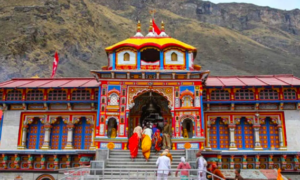
- Badrinath is the last or the final stop of the four Dhams. We will take a 7 hour ride to Badrinath through Joshimath. And will also be staying there for the night.
- Badrinath is located in the Chamoli district Uttarakhand and is considered the seat of Lord Vishnu. This place is decorated by wild berries and there for egets its name, “Badri van” or the “forest of berries”.
- While on our way to Joshimath, we will take a small stop at the Adi Shankaracharya Math and the Narsingh Temple.
- Resting at an altitude of 300 meters above the sea level, the Badrinath temple is surrounded by Nar and Narayan mountains on each side.
- There are a number hot water springs around Badrinath temple. It is so believed that the Badrinath idol was discovered in the Narad Kund Pool.
- The Badrinath temple seems like a dream with beautiful mountains in the backdrop. A lot of stories and legends are attached to this temple as well. It is believed that Lord Vishnu came here and immersed himself in complete meditation after Sage Narada rebuked him for being occupied with worldly pleasures.
- The entire day here would be full of sightseeing and enjoying the immensely calm and tranquil aura of this place.
- We will stay at Badrinath this night.
Day 9: Badrinath to Rudraprayag
- This is where our journey of the Char Dhams will come to an end. The return journey involves a devotional path involving Rudraprayag and Rishikesh on the way.
- The devotees have a chance to take a quick bath in Taptkund on their way back.
- We shall make a small stop at Joshimath before reaching Rudraprayag. It is here that we will witness a divine confluence of the Alaknanda and Dhauliganga rivers.
- Joshimath is considered to be one of the four “Maths” established by Adi Shankaracharya.
- Rudraprayag on the other hand marks the convergence of the Alaknanda and Mandakini rivers.
- The night would be spent at a hotel in Rudraprayag itself.
Day 10: Rudraprayag to haridwar
- The last leg of this journey would be a 5-hour drive to Haridwar. We will leave for Haridwar after having breakfast in Rudraprayag.
- This drive would pass through some of the most prominent and popular towns of Uttarakhand like Devprayag, Srinagar, and Rishikesh.
- This drive would be through the mountains and beautiful valleys.
- Ending the Char Dham yatra with a dip in the sacred Ganga River would be the best way to let go of all the tiredness.
- The journey of adventure, spirituality, and unmatched tranquility comes to an end here in Haridwar